3 Ligaments Of The Elbow - Your Quick Ucl Rehabilitation Guide Performance Health Academy / The anterior bundle is considered to be the most important stabiliser of the elbow and provides valgus and posteromedial stability.
Get link
Facebook
X
Pinterest
Email
Other Apps
3 Ligaments Of The Elbow - Your Quick Ucl Rehabilitation Guide Performance Health Academy / The anterior bundle is considered to be the most important stabiliser of the elbow and provides valgus and posteromedial stability.. Distally, it attaches to the annular ligament of the radius and coronoid process of the ulna 1,3,5. Ulnar collateral ligament or ucl, lateral collateral ligament and annular ligament form the ligaments in elbow. An elbow sprain is when you stretch or tear one, two or all three ligaments which provide support for your elbow. When the ligament is injured, it could be stretched, partially torn, or completely torn. Here we will look in detail about the ligaments, the common injuries affecting them, how they are diagnosed and treated.
Add to favorites 4 favs. When the ligament is injured, it could be stretched, partially torn, or completely torn. Here we will look in detail about the ligaments, the common injuries affecting them, how they are diagnosed and treated. Online quiz to learn ligaments of elbow; It is a part of the lateral (radial) collateral ligament complex and located at the posterolateral aspects of the elbow joint.
Elbow Wikipedia from upload.wikimedia.org But there are a few other muscles involved that all relate to the biceps and triceps in a way. Located on the inside of the elbow this ligament connects the ulna to the humerus. When the ligament is injured, it could be stretched, partially torn, or completely torn. The anterior bundle is considered to be the most important stabiliser of the elbow and provides valgus and posteromedial stability. Add to favorites 4 favs. The medial collateral ligament of the elbow can be divided into three components, the anterior, the posterior, and the transverse bundles 4,13,15,26 (fig 2). Occurs between the trochlea and capitulum of the humerus and the trochlear notch of the ulna and the head of the radius. Ligaments are strong connective tissue structures that join bone to bone, providing stability to the elbow.
Ulnar collateral ligament injury (elbow) 4.
The ulna collateral ligament, on the medial side of the elbow, connects the ulna to the humerus. But there are a few other muscles involved that all relate to the biceps and triceps in a way. Superior depiction of muscles, ligaments, and tendons as well as the ability to directly visualize nerves, bone marrow, and hyaline cartilage are advantages of magnetic resonance imaging relative to conventional imaging techniques. Ligaments are responsible for holding bones together physiologically like strong bands of tissue. The humeroulnar and the humeroradial joints each have a ligament connecting the two bones involved at the articulation: The upper border is continuous with the capsule of the elbow joint while the lower border is free surrounding the neck of the radius. The lateral ulnar collateral ligament (ucl) is the ligament that commonly gets injured for pitchers in. Ligaments related to superior radioulnar joint. This leads to pain and tenderness on the lateral side of the elbow. The medial and lateral collateral ligaments provide valgus and varus stability, and allow for rotation. The elbow is the visible joint between the upper and lower parts of the arm.it includes prominent landmarks such as the olecranon, the elbow pit, the lateral and medial epicondyles, and the elbow joint.the elbow joint is the synovial hinge joint between the humerus in the upper arm and the radius and ulna in the forearm which allows the forearm and hand to be moved towards and away from the body. Both sections arise from the medial epicondyle and pass over the inside of the elbow joint. The ligaments which hold your elbow bones together are the medial, lateral and annular ligaments.
An elbow sprain is when you stretch or tear one, two or all three ligaments which provide support for your elbow. There are a collection of ligaments that connect the bones forming the elbow joint to each other, contributing to the stability of the joint. You need to get 100% to score the 7 points available. The lateral ulnar collateral ligament (ucl) is the ligament that commonly gets injured for pitchers in. Ligaments are strong connective tissue structures that join bone to bone, providing stability to the elbow.
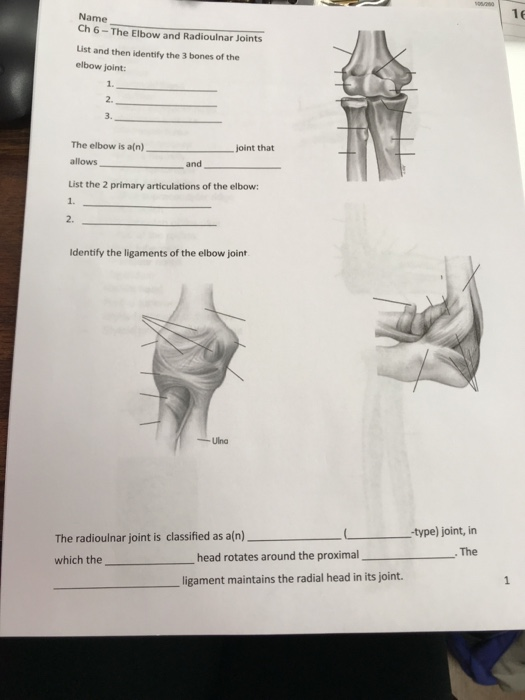
Solved 16 Name Ch 6 The Elbow And Radioulnar Joints List Chegg Com from media.cheggcdn.com Both the radial and lateral ulnar collateral ligaments provide the bulk of the elbows stability by holding the humerus and ulna tightly together. The anterior bundle is considered to be the most important stabiliser of the elbow and provides valgus and posteromedial stability. Elbow joint and radioulnar joints dr. An elbow sprain is when you stretch or tear one, two or all three ligaments which provide support for your elbow. The radial collateral ligament is found on the lateral side of the joint, extending from the lateral epicondyle, and blending with the annular ligament of the radius (a ligament from the proximal radioulnar joint). The elbow is the visible joint between the upper and lower parts of the arm.it includes prominent landmarks such as the olecranon, the elbow pit, the lateral and medial epicondyles, and the elbow joint.the elbow joint is the synovial hinge joint between the humerus in the upper arm and the radius and ulna in the forearm which allows the forearm and hand to be moved towards and away from the body. The anconeus which can be seen as a continuation of the triceps helps with extension. It takes its course immediately posterior to the radial collateral ligament and further distally posterior to.
Lateral epicondyle to annular ligament.
Magnetic resonance imaging provides clinically useful information in assessing the elbow joint. The anterior oblique ligament (aol) attaches from the undersurface of the medial epicondyle to the medial ulnar surface slightly below the coronoid process. Involved tissue in medial elbow injuries. The important ligaments of the elbow are the medial collateral ligament (on the inside of the elbow) and the lateral collateral ligament (on the outside of the elbow.) together these ligaments provide the main source of stability for the elbow, holding the humerus and the ulna tightly together. Lateral epicondyle to annular ligament. Superior depiction of muscles, ligaments, and tendons as well as the ability to directly visualize nerves, bone marrow, and hyaline cartilage are advantages of magnetic resonance imaging relative to conventional imaging techniques. The ulna collateral ligament, on the medial side of the elbow, connects the ulna to the humerus. An elbow sprain is when you stretch or tear one, two or all three ligaments which provide support for your elbow. Occurs between the trochlea and capitulum of the humerus and the trochlear notch of the ulna and the head of the radius. An ulnar collateral ligament (ucl) tear is an injury to a ligament in your elbow. Online quiz to learn ligaments of elbow; Ligaments the joint capsule of the elbow is strengthened by ligaments medially and laterally. It extends from the medial epicondyle of the humerus to ulnar tuberosity on the medial aspect of the coronoid process and the medial aspect of the trochlear notch/olecranon of the ulna.
Ulnar collateral ligament or ucl, lateral collateral ligament and annular ligament form the ligaments in elbow. But there are a few other muscles involved that all relate to the biceps and triceps in a way. Sprain or tearing of the ucl due to valgus stress leading to pain and dysfunction. The humeroulnar and the humeroradial joints each have a ligament connecting the two bones involved at the articulation: The anterior portion then attaches to the front part of the top of the ulna.
Anatomy Of The Elbow Musculoskeletal Key from i2.wp.com Sprain or tearing of the ucl due to valgus stress leading to pain and dysfunction. This leads to pain and tenderness on the lateral side of the elbow. Triangular ligament located on the medial side of the elbow. 3 ligaments of the elbow joint. Lateral epicondyle to supinator crest Superior depiction of muscles, ligaments, and tendons as well as the ability to directly visualize nerves, bone marrow, and hyaline cartilage are advantages of magnetic resonance imaging relative to conventional imaging techniques. There are four main ligaments in the elbow. The medial and lateral collateral ligaments provide valgus and varus stability, and allow for rotation.
The upper border is continuous with the capsule of the elbow joint while the lower border is free surrounding the neck of the radius.
An ulnar collateral ligament (ucl) tear is an injury to a ligament in your elbow. This leads to pain and tenderness on the lateral side of the elbow. The mclc is comprised of the anterior bundle, posterior bundle and transverse ligament (the ligament of cooper). The anterior bundle is considered to be the most important stabiliser of the elbow and provides valgus and posteromedial stability. There are four main ligaments in the elbow. The anterior oblique, posterior oblique and transverse ligaments. Add to playlist 5 playlists. Triangular ligament located on the medial side of the elbow. This ligament prevents the radius from rolling away from the ulna when we rotate the elbow. The important ligaments of the elbow are the medial collateral ligament (on the inside of the elbow) and the lateral collateral ligament (on the outside of the elbow.) together these ligaments provide the main source of stability for the elbow, holding the humerus and the ulna tightly together. Ligaments are responsible for holding bones together physiologically like strong bands of tissue. The anconeus which can be seen as a continuation of the triceps helps with extension. It extends from the medial epicondyle of the humerus to ulnar tuberosity on the medial aspect of the coronoid process and the medial aspect of the trochlear notch/olecranon of the ulna.
The ulnar collateral ligament (ucl, also known as medial collateral ligament) is located on the medial side of the elbowthe ucl complex comprises three ligaments: 3. liga. The radial collateral ligament is found on the lateral side of the joint, extending from the lateral epicondyle, and blending with the annular ligament of the radius (a ligament from the proximal radioulnar joint).


Comments
Post a Comment